JP.cars software
Software for automated car valuations, optimising prices and stock, plus purchase advice – locally and cross-border. View all options of JP.cars.
Data insights for the automotive industry — Join 6,000 subscribers

JP.cars software
Software for automated car valuations, optimising prices and stock, plus purchase advice – locally and cross-border. View all options of JP.cars.
Data insights for the automotive industry — Join 6,000 subscribers
Data insights for the automotive industry — Join 6,000 subscribers
Questions? Contact us via jp@jp.cars•+31 20 700 8315
Prsentation Deutscher Remarketing Congress
Over the past months, pricing behaviour in the German used car market has become increasingly reactive. Average prices are declining, while the frequency and size of price adjustments continue to rise. Dealers are changing prices more often and earlier, yet many are struggling to protect margins.

Patrick Waringer presenting at the Deutscher Remarketing Congress
According to Patrick Waringer, Director of Sales and Business Development DACH at JP.cars, this trend is not simply the result of tougher market conditions.
“Visibility on online car marketplaces has become the dominant objective,” Waringer explains. “Pricing decisions are increasingly driven by the goal of regaining or defending a position on the first page, often without questioning whether that move makes economic sense.”
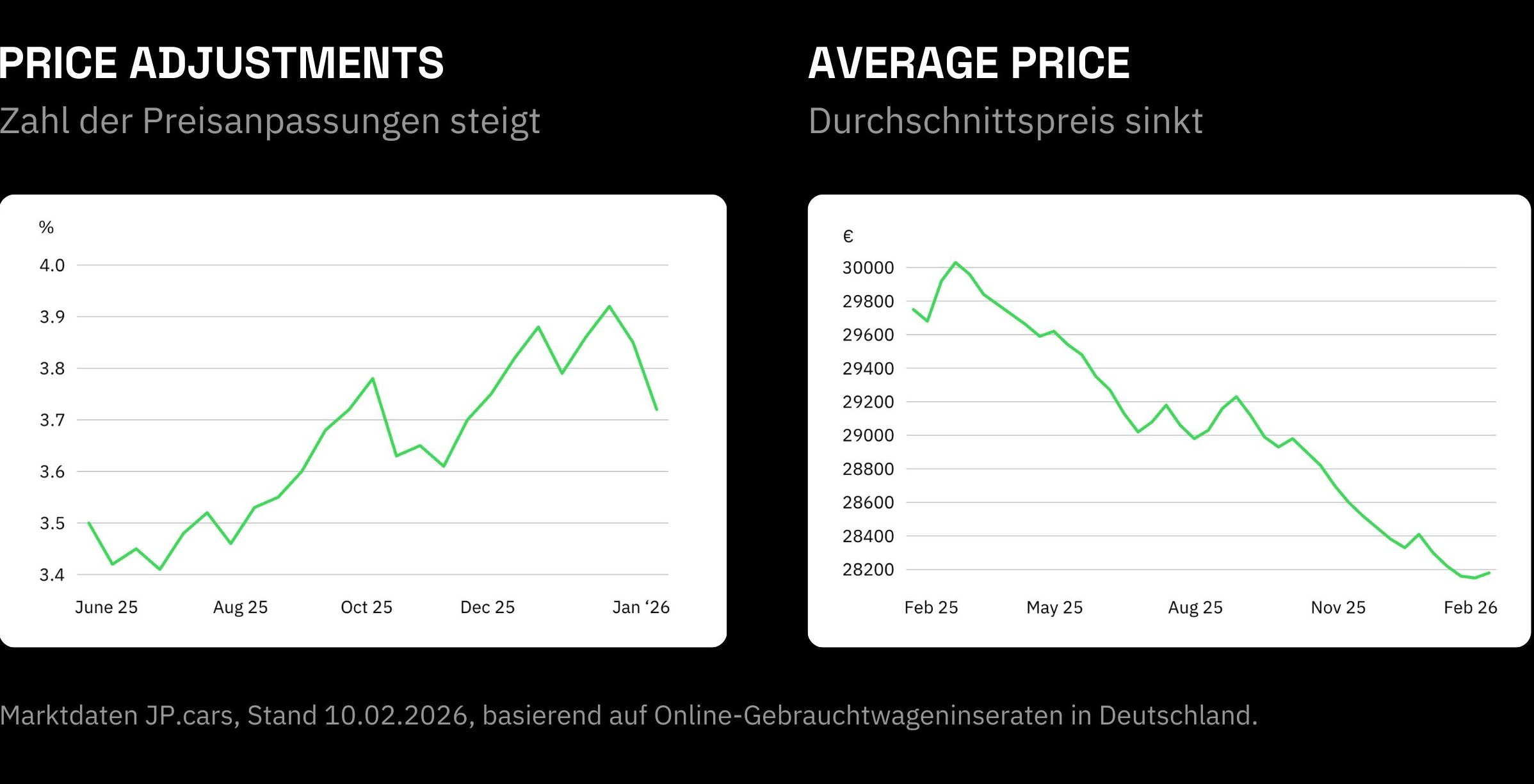
Many automotive companies rely on competitor-focused pricing tools that continuously benchmark listings against each other. When a vehicle drops in ranking, the suggested response is usually straightforward: reduce the price.
This creates a self-reinforcing pattern. Cars are repriced multiple times during their lifecycle, often within short intervals. Discounts are applied not because demand is weak, but because competitors have moved first.
“The assumption is that being cheaper automatically means selling faster,” Waringer says. “In reality, that link is far less direct. A car can still sell at a higher price if demand is there.” As a result, pricing becomes reactive by default. Decisions are made to satisfy rankings and dashboards rather than to reflect actual market appetite.
According to Waringer, the industry has become very good at monitoring competitors, but far less consistent in measuring demand. “As an industry we track each other’s prices in detail,” he says. “What is often missing is a structured understanding of how likely a specific car is to sell at a given price.”
Without that insight, every competitor discount feels urgent. This leads to defensive pricing behaviour, even when it is not economically justified. “This is especially problematic for cars with solid demand,” Waringer explains. “Those vehicles will sell. Sometimes it takes slightly longer, but the additional margin often outweighs the extra time in stock.”
In the JP.cars software, demand is quantified using ETR. This metric indicates the marketability of a car based on trends in stock and sales data. “This changes the pricing logic,” Waringer says. “Instead of asking who is cheaper today, dealers can assess whether a car is priced in line with its demand profile.”
In practice, this allows automotive companies to hold prices with confidence when demand supports it, and to intervene only when demand signals actually weaken.
Waringer points to German dealers such as Auto Mattern, where demand insight based on JP.cars data has brought more structure into pricing and stock decisions. Vehicles are prioritised based on expected sellability rather than short-term ranking movements.
“Because demand is already assessed before purchase, fewer slow-moving cars enter stock,” he says. “That reduces the need for heavy discounting later.”
The effects of demand-led pricing are visible in day-to-day operations. According to Waringer, companies reduce unnecessary repricing cycles and avoid early discounts on cars that are still performing.

“This leads to more stable margins per vehicle and better control over stock ageing,” he says. “Cars that previously would have been discounted too early are allowed to sell at their natural market price.”
Sales teams benefit as well. With clearer pricing logic, negotiations become more controlled and consistent. “Teams are no longer constantly reacting to the market. They trust the pricing strategy and know why a price is held or adjusted.”
“The race to the bottom is not inevitable,” Waringer concludes. “It is the outcome of pricing decisions made without demand insight.” He adds: “When automotive companies understand demand, they gain the freedom to ignore unnecessary price wars. The first page should be the result of good decisions, not the objective.”
JP.cars continues to see growing adoption in Germany as more companies move away from competitor-reactive pricing models towards demand-led strategies.
JP.cars is a fast-growing automotive technology company supporting used car professionals across Europe. In Germany, JP.cars helps automotive companies with automated vehicle valuations and residual value assessments based on real market data and their own pricing strategy.
The software enables continuous stock valuation and price optimisation, provides market insights that mirror a company’s own inventory, and delivers local and cross-border purchasing advice with clear visibility into margin potential and expected turnover speed.
Learn more
Discover JP.cars software
JP.cars software
Software for automated car valuations, optimising prices and stock, plus purchase advice – locally and cross-border. View all options of JP.cars.


 Head office
John M. Keynesplein 1
1066 EP Amsterdam
Netherlands
jp@jp.cars
+31 20 700 8315
Data insights for the automotive industry — Join 6,000 subscribers
Data insights for the automotive industry — Join 6,000 subscribers

